Introduction: The Global Landscape of Intellectual Property and Territorial Jurisdiction
Intellectual property rights, by their very nature, are strictly territorial. A patent granted by the United States Patent and Trademark Office (USPTO) provides statutory exclusivity only within the borders of the United States and its territories. To secure comprehensive global protection and exclusionary rights, innovators must navigate a fragmented mosaic of national and regional patent offices, each governed by its own sovereign laws, distinct statutory requirements, examination standards, and procedural rules.
This fragmentation continues to create substantial administrative friction, high transaction costs, and immense procedural duplication. An applicant seeking worldwide protection must file separate, independent patent applications in multiple individual countries simultaneously, complying with local language requirements, paying localized maintenance and translation fees, and prosecuting the claims through disparate administrative bodies. While the international intellectual property community is actively deploying cooperative treaties, harmonization frameworks, and digital infrastructure to streamline prosecution, significant structural divergences remain. Major intellectual property offices—including the USPTO, the European Patent Office (EPO), the China National Intellectual Property Administration (CNIPA), the Japan Patent Office (JPO), and the Ministry of Intellectual Property of the Republic of Korea (MOIP)—all share the fundamental objective of rewarding technical innovation, but their internal workflows, pendency rates, and domestic filing volumes vary dramatically. Therefore, international patent filers must understand the nuances of different jurisdictions and adopt sophisticated multi-jurisdictional strategies.
Section 1: The Foundation of International Filings — The Patent Cooperation Treaty (PCT)
Introduced to bridge the gap between divergent national systems, the Patent Cooperation Treaty (PCT) is an international treaty administered by the World Intellectual Property Organization (WIPO). With over 150 contracting states, the PCT system allows an applicant to file a single international patent application—known as a “PCT application”—in one language through a single receiving office.
It is important to clarify that filing a PCT application does not produce a legally enforceable patent. Instead, the PCT acts as a streamlined priority mechanism that sets a widely recognized priority date and centralizes the initial prior art search and preliminary patentability assessment. Obtaining legally enforceable patent rights still requires subsequent, separate timely filings in individual national or regional jurisdictions and a proper claim of priority to the PCT application.
The Two-Phase Structure of the PCT
The PCT process is divided into two primary operational phases:
- The International Phase:
- International Filing & Search: Following the filing of a PCT application, an International Searching Authority (ISA)—such as the USPTO, EPO, or JPO—conducts a comprehensive prior art search and issues an International Search Report (ISR) alongside a Written Opinion of the International Searching Authority (WO/ISA). This document provides an early, objective assessment of the invention’s potential patentability (novelty, inventive step, and industrial applicability).
- International Publication & Optional Chapter II: The application is published internationally by WIPO, exposing the invention to the global marketplace. Applicants may also optionally file a Demand for International Preliminary Examination (Chapter II) to receive a more detailed, reasoned opinion on patentability and an opportunity to amend claims before entering individual national markets.
- The National (or Regional) Phase:
- Typically 30 to 31 months from the earliest priority date, the international phase concludes and the national phase commences. To initiate the national phase, the applicant must file in designated countries or regions before the conclusion of the international phase. The applicant must then fulfill specific national requirements in each designated country or region where they wish to secure patent protection. This involves paying national filing fees, providing certified translations where necessary, and appointing local patent agents to prosecute the application through individual national patent offices.
The primary advantage of the PCT system is that it defers the substantial financial and administrative burdens of localized national filings by roughly 30 months, giving innovators crucial time to evaluate commercial viability, secure funding, and refine their market strategies before committing to expensive foreign prosecution.
Section 2: Regional Harmonization — The Rise of the Unitary Patent and Unified Patent Court (UPC)
While the PCT manages the preliminary international stage of filings, regional systems have evolved to simplify post-grant enforcement and administration. The most transformative development in modern international patent practice is the establishment of the European Unitary Patent (UP) and the Unified Patent Court (UPC).
For decades, obtaining patent protection in Europe required applicants to navigate separate examinations at each of the local offices or utilize the centralized examination and grant procedures of the European Patent Office (EPO), followed by a cumbersome, expensive “validation” process in individual European Union member states. Once validated, enforcing or invalidating those patents required separate, costly litigation in national courts across multiple countries, frequently resulting in conflicting legal outcomes.
The operational launch of the European Unitary Patent and the UPC fundamentally streamlined this framework:
- The European Unitary Patent (UP): A single European patent with unitary effect across participating EU member states, granted by the EPO under centralized rules. It eliminates the need for fragmented national validations, drastically lowering translation and administrative maintenance costs when protection in many jurisdictions is desired.
- The Unified Patent Court (UPC): A specialized, multinational patent court shared by participating EU member states. The UPC has exclusive jurisdiction over litigation concerning both classical European patents and new Unitary Patents. A single ruling by the UPC regarding infringement or revocation applies directly across all participating member states, replacing the need for parallel multi-country litigation.
The implementation of the UPC and Unitary Patent system highlights a broader global trend: major jurisdictions are actively deploying structural reforms to reduce administrative duplication, lower cross-border legal costs, and modernize intellectual property enforcement.
Section 3: Strategic Realignment in U.S. Patent Practice — The USPTO’s 2026 Initiatives
Against the backdrop of shifting global filing volumes and domestic examination backlogs, the U.S. Patent and Trademark Office has enacted sweeping policy updates under Director John A. Squires.
Data compiled by WIPO reveals a changing global distribution of intellectual property generation. While global PCT filings reached approximately 275,900 in 2025 (a modest 0.7 percent annual increase), growth is increasingly concentrated in Asia, which commands 57 percent of global filing activity. Specifically, CNIPA (China) led with 78,648 filings (+5.3%), followed by the USPTO with 49,032 filings (-3.0%), the JPO with 46,409 (-1.0%), the EPO with 39,332 (consistent), and MOIP with 24,950 (+4.9%).
Faced with declining domestic PCT volumes and persistent backlogs, the USPTO has introduced targeted administrative measures to align U.S. national stage practice with international examination models and optimize internal examination inventories.
The PIER Pilot Program: Aligning U.S. Practice with Global Standards
Initiated on May 21, 2026 (following a Federal Register notice on April 9, 2026), the PCT Informed Examination Request (PIER) pilot program represents a major structural shift. In many international patent offices, applicants must formally request substantive examination and pay a corresponding fee after entering the national phase, providing a natural checkpoint to evaluate commercial viability. Historically, U.S. national stage applications entered the examination queue automatically. The PIER program introduces an active “confirm-to-proceed” mechanism that forces selected applicants to make explicit prosecution and commercialization decisions prior to the commencement of substantive U.S. examination. The specific administrative requirements are covered in our article on 2026 USPTO initiatives available at https://www.losey.law/tackling-the-patent-backlog-the-usptos-2026-examination-reform-initiatives/.
Section 4: Streamlining International Practice: Accelerated Patent Grant Arrangements and Regional Outreach
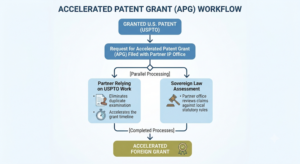
Beyond managing internal backlogs, the USPTO is actively expanding bilateral worksharing frameworks to streamline global prosecution. One mechanism is an accelerated patent grant framework which allows an applicant to submit a request to accelerate examination based on a granted patent in a partner jurisdiction. This applicant-driven strategy allows foreign patent offices to rely on USPTO search and examination results, and to reduce duplicate efforts for U.S. innovators abroad. An example workflow is shown in FIG. 1.
The Historic U.S.-Ghana APG Agreement
On July 9, 2026, in Geneva, Switzerland, USPTO Director John A. Squires and Ghana’s Registrar-General Grace Ama Issahaque signed a historic five-year statement of intent establishing an Accelerated Patent Grant (APG) arrangement between the USPTO and Ghana’s IP office, the Registrar General’s Department, Ministry of Justice (GHIPO).
- First African Partnership: This agreement marks the USPTO’s first fast-grant worksharing arrangement with an African nation.
- Regional Strategic Positioning: Built on the momentum of installing the USPTO’s first regional IP attaché, Katherine Hiner, in Johannesburg, South Africa.
- Economic Integration: Ghana’s GDP reached $114 billion in 2025, and in 2024, 33 percent of all foreign patent applications in Ghana originated from U.S.-based filers.
Mechanically, GHIPO utilizes USPTO search and patentability determinations while retaining sovereign authority to ensure compliance with Ghanaian patent law.
The Expanding Global APG and Worksharing Network
The Ghana agreement represents the 10th APG arrangement concluded by the USPTO globally:
| Partner Country | Partner Office | Agreement Date / Status |
| Cambodia | MISTI | October 2020 (Active) |
| Panama | DIGERPI | February 2023 (Active) |
| Mexico | IMPI | August 2023 (Active) |
| Dominican Republic | ONAPI | April 2024 (Active for 5 years) |
| Trinidad and Tobago | TTIPO | July 2024 (Active) |
| El Salvador | CNR | August 2024 (Active through August 20, 2029) |
| Belize | BELIPO | July 2025 (Active) |
| Guatemala | RPI | July 2025 (Active) |
| United Arab Emirates | UAE MOE | July 2025 (Active) |
| Ghana | GHIPO | July 9, 2026 (Active for 5 years) |
Section 5: Infrastructure Modernization and Global Governance
To support these operational changes, the USPTO is modernizing international and administrative infrastructure:
- International Patent Assignment Initiative: Launched July 14, 2026, featuring a cross-functional “tiger team” tasked with simplifying cross-border patent ownership and recordation under the PCT.
- WIPO Leadership Alignment: On July 9, 2026, WIPO’s Coordination Committee approved the appointment of Laura Peter (former Deputy Under Secretary for Commerce and Deputy Director of the USPTO, 2018–2021) as the next Deputy Director General of WIPO’s Patents and Technology Sector for a six-year term beginning October 1, 2026. This leadership transition establishes a direct channel of coordination between the USPTO and WIPO.
- Domestic Digital Updates: Including the redesign of Patent Trial and Appeal Board (PTAB) web pages, the transition of outbound international trademark applications to WIPO’s Madrid e-Filing platform (July 15, 2026), and a 5-year technology transfer MOU with NASA’s Space Technology Mission Directorate.
Strategic Recommendation for Corporate Intellectual Property Portfolios
- Follow Administrative Requirements: Meticulously follow the procedural requirements for the PCT and international mechanisms to ensure proper priority and rights for your national stage filings.
- Strategically Select Paths and Jurisdictions for Protections: Each path has unique requirements, benefits, and potential disadvantages that are important to consider when deciding on an international filing strategy.
- Leverage the Global APG Network: Actively utilize granted U.S. patents to request accelerated grants in emerging and partner markets (such as Mexico, the UAE, and Ghana) and ensure pre-emptive claim alignment to accelerate international market entry.
Conclusion
Navigating the global intellectual property landscape remains a complex, territorial endeavor that requires a deep understanding of varying national laws, strategic foresight, and meticulous administrative execution. However, the recent policy implementations from the USPTO and other international bodies illustrate a concerted, structural effort to harmonize fragmented practices and streamline the international prosecution process.
From the foundational centralization offered by the PCT and the transformative regional integration of the European Unitary Patent, to the USPTO’s rapidly expanding Accelerated Patent Grant (APG) network, the overarching goal is clear: to reduce procedural duplication and lower the transaction costs of protecting innovation worldwide. While applicants must be highly vigilant to comply with strict and still varying jurisdictional requirements, they simultaneously gain access to powerful, streamlined pathways to rapidly expand their intellectual property protection across emerging global markets.